

Custom Orthotics vs. Insoles: What’s Actually Worth It? 2026 Guide

Most people looking for foot support end up stuck between two imperfect options: inexpensive drugstore inserts that mostly add cushioning, or prescription custom orthotics that can cost several hundred dollars and require a clinic visit.
The real question is not just “custom orthotics vs. insoles.” It is: how much support do you actually need, how personalized does the fit need to be, and when is it worth paying more?
In this guide, we’ll break down the difference between over-the-counter insoles, prescription custom orthotics, and at-home custom-molded options like Contour.
What’s the difference between OTC insoles, orthotic inserts, and custom orthotics?
The terms “insole,” “insert,” and “orthotic” are often used interchangeably, but they do not always mean the same thing.
An insole or shoe insert is usually a removable footbed placed inside a shoe to add cushioning, comfort, or support. Many over-the-counter options are mass-produced and sold in broad size ranges. Some are soft and cushion-focused, while others offer more structure through arch support or a firmer shell.
Prescription custom orthotics are different. They are made after an evaluation by a medical professional and are designed around a person’s specific foot structure, symptoms, gait, and medical needs. They can be especially useful for complex foot mechanics, severe deformities, or medical conditions that require professional oversight.
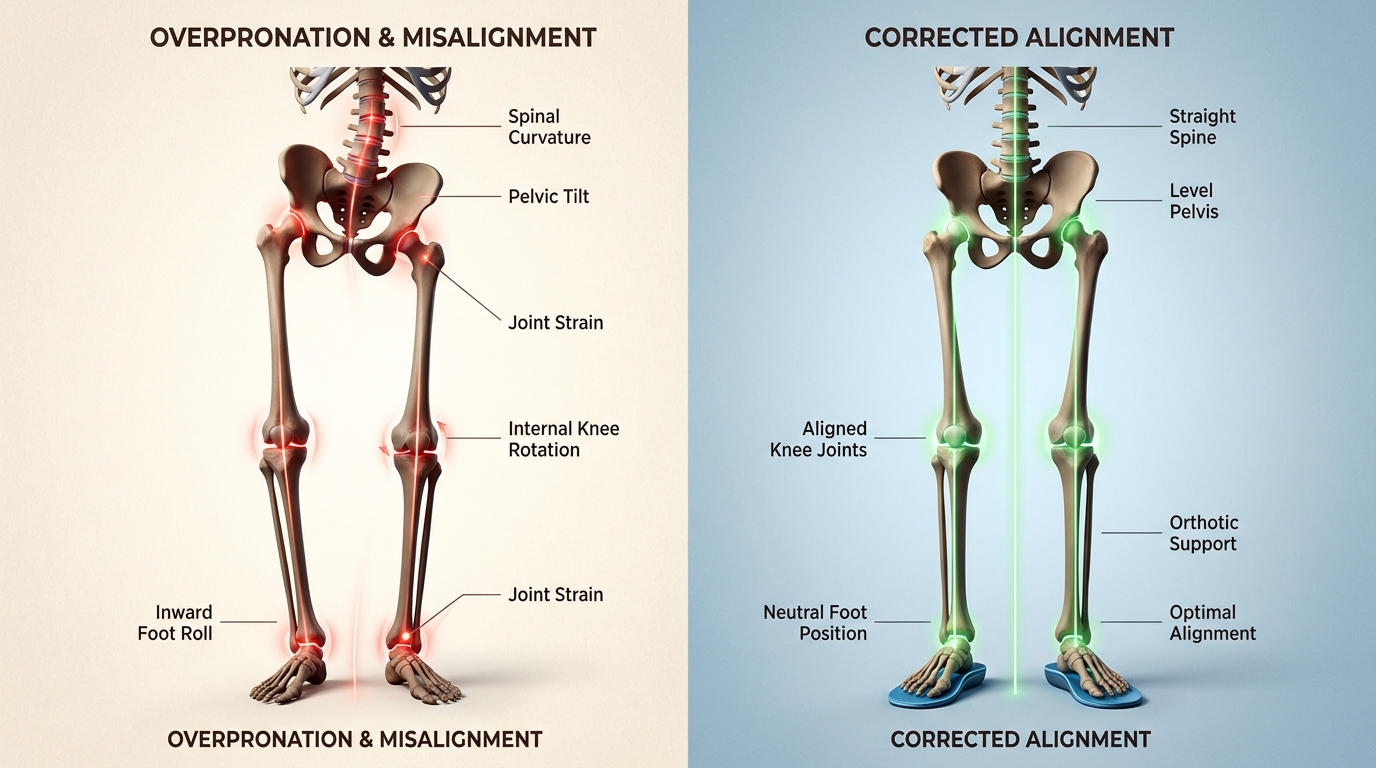
The main difference comes down to personalization and purpose. If your feet are generally healthy and you just want more comfort during long days, a high-quality OTC insole may be enough. If you have recurring heel pain, arch pain, knee discomfort, or a known foot condition, you may need a more structured support system.
Why fit and firmness matter more than softness
One of the biggest misconceptions in foot support is that softer is always better. When your feet hurt, it makes sense to reach for the softest gel insert you can find. It may feel good for the first few minutes, but soft material often compresses under body weight.
When an insert compresses too much, it may stop supporting the arch. That means your foot can continue to collapse or roll in the same way that contributed to the discomfort in the first place. Firm support helps distribute pressure more evenly and gives the foot a more stable foundation.
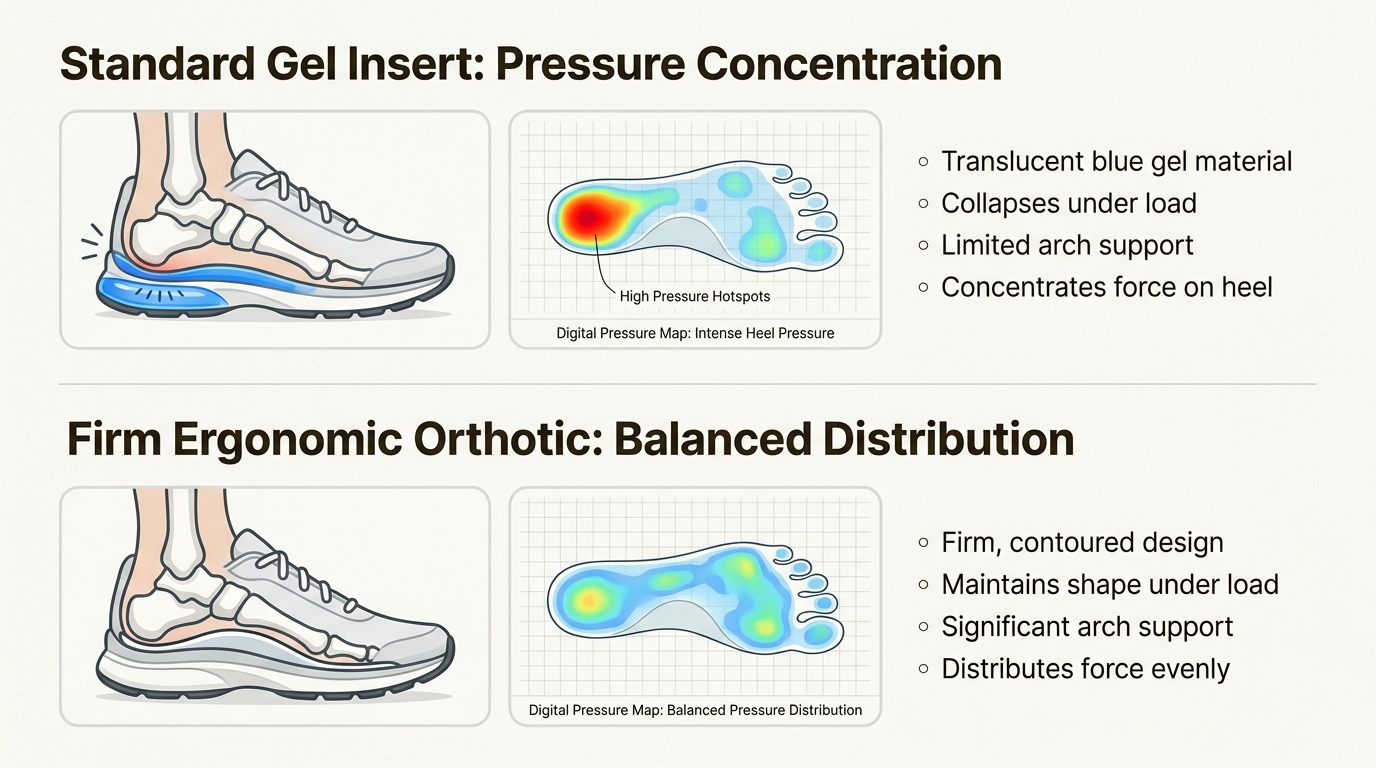
Fit matters just as much. Generic trim-to-fit inserts are built for average foot shapes, which means they may leave gaps under the arch or create pressure in the wrong places. A better fit helps the insole support the areas that actually need support.
The middle ground: At-home custom-molded orthotics
For years, many people felt stuck between two options: a low-cost drugstore insert or an expensive clinic-made orthotic. At-home custom-molded technology creates a third option.
Contour Custom Pro was developed to provide a more personalized fit than generic OTC insoles, without requiring a traditional clinic appointment or lab-made process.
Contour uses a water-activated molding system that shapes to your foot while you are standing and moving in your own shoes. The process takes about 15 minutes:
- Inject: Add water into the insole using the included syringe.
- Walk: Place the insoles into your shoes and walk for about 5 minutes so the material can shape under body weight.
- Set: Sit and let the material finish setting into a firmer, supportive shape.
The result is a personalized fit that captures your arch shape under real body weight, inside the shoes you actually wear. That makes Contour different from generic trim-to-fit inserts and from mail-away custom systems that require impressions, scans, or lab production.
Contour references University of Tokyo testing showing similar biomechanical support patterns compared with traditional custom orthotics, including pressure distribution and stability measures. This does not mean every person should skip medical care, but it does show why at-home custom-molded support can be a serious option for many everyday users.
Comparison: OTC insoles vs. custom orthotics vs. at-home custom fit
When deciding which path to take, it helps to compare support, fit, timing, and budget side by side.
| Feature | OTC Insoles | Traditional Custom Orthotics | Contour Custom Pro |
|---|---|---|---|
| Fit Type | Generic or trim-to-fit | Clinic-evaluated and lab-made | Molded at home inside your shoe |
| Support Level | Varies; often cushion-focused | High, based on clinical evaluation | Structured, custom-molded support |
| Wait Time | Immediate | Often 2 to 4 weeks | About 15 minutes |
| Personalization | Low to moderate | High | High, molded under body weight |
| Typical Price | $20 to $60 | $300 to $600+ | $150 |
How other insole options compare
Different brands solve the fit problem in different ways. Some use pre-made arch shapes, some use kiosks, and some use scans or mail-away impressions.
Dr. Scholl’s Custom Fit
Dr. Scholl’s Custom Fit uses FootMapping technology to recommend one of several pre-made insert options. This can be more personalized than grabbing a random foam insert, but it is still matching the customer to an existing insert rather than molding to the exact shape of the foot.
PowerStep
PowerStep offers structured, podiatrist-designed support options. These can be a strong choice for people who want more support than basic foam, but the fit is still based on a pre-shaped shell rather than a mold created from the user’s own foot.
Upstep
Upstep uses an at-home impression kit and then manufactures custom orthotics from the impression. This provides a custom-made product without a clinic visit, but the process still involves sending impressions and waiting for the finished orthotics to arrive.
Superfeet ME3D
Superfeet ME3D uses biometric scanning and 3D printing to create personalized support. This can be a strong custom option, but it may require access to a participating retailer or scanning process.
FitMyFoot
FitMyFoot uses smartphone scanning to create custom 3D-printed insoles. It is another custom option for people who want a more personalized fit, but the process still includes manufacturing and shipping time.
When should you see a podiatrist for foot pain?
At-home support can be a helpful option for many people, but it is not a replacement for professional medical care. You should schedule an appointment with a podiatrist or medical professional if:
- Pain is severe or worsening: If you cannot put weight on your foot or the pain is getting worse over time.
- You have diabetes or neuropathy: Foot pain, numbness, ulcers, or skin changes should be evaluated by a professional.
- You have numbness or tingling: This can suggest nerve involvement rather than simple fatigue or soreness.
- You recently had foot or ankle surgery: You may need a specific medical recommendation before changing support.
- You have structural deformities: Severe bunions, hammertoes, rigid flatfoot, or significant misalignment may require a professional evaluation.
For everyday foot fatigue, arch discomfort, mild overpronation, or recurring soreness from long periods of standing, a high-quality support option may be a practical place to start.
Choosing the right foot support for your lifestyle
The best choice depends on your daily activity, your symptoms, your budget, and whether you need medical oversight.
If you are an athlete or runner
You need support that can handle repeated impact without flattening quickly. A soft gel insert may feel good at first, but a firmer structure is often more useful for keeping the foot stable over repeated steps.
If you stand all day for work
The priority is long-term support that holds up through long shifts. If your feet feel fine for the first hour but ache by the end of the day, the issue may be that your current insert is compressing or failing to support your arch under load.
If you are dealing with plantar fasciitis or recurring heel pain
The key is consistency. You need support that helps distribute pressure and reduce unnecessary strain through the heel and arch. You can learn more in our guide to the best insoles for plantar fasciitis.
Contour was built for people who want more than temporary cushioning but do not want to wait weeks for a lab-made orthotic. The Custom Pro molds inside your own shoe in about 15 minutes and is backed by a 60-day “Back On Your Feet” Guarantee.
Ready to try custom-molded support?
Contour Custom Pro is designed to give you a personalized fit without a clinic appointment, lab wait, or generic trim-to-fit guesswork.
Frequently Asked Questions
What is the main difference between custom orthotics and OTC insoles?
OTC insoles are usually mass-produced and designed for general comfort or support. Custom orthotics are made around a person’s specific foot structure, symptoms, and clinical needs. At-home custom-molded options like Contour sit between the two by offering a personalized fit without the traditional clinic process.
Are custom orthotics worth the higher price?
They can be worth it for people with complex foot mechanics, severe symptoms, or medical conditions that require professional evaluation. For many everyday users, an at-home custom-molded insole may offer a more practical middle ground between cheap inserts and expensive prescription orthotics.
Do I need custom orthotics for plantar fasciitis?
Not everyone needs prescription custom orthotics for plantar fasciitis. Many people start with supportive shoes, stretching, load management, and structured arch support. If pain is severe, worsening, or not improving, it is best to speak with a podiatrist.
Can at-home custom-molded insoles replace prescription orthotics?
At-home custom-molded insoles can be a strong option for many people who want more personalized support than generic insoles. They are not a replacement for medical care when there are severe deformities, diabetic foot concerns, recent surgery, neuropathy, or complex medical issues.
How long do custom orthotics usually last?
Traditional custom orthotics can often last several years depending on materials, usage, body weight, and activity level. Contour is built with durable materials designed for long-term support, but lifespan can vary based on how often you wear them and the shoes you use them in.
When should I see a podiatrist instead of buying insoles?
See a podiatrist if you have severe pain, worsening symptoms, numbness, tingling, diabetes, ulcers, recent surgery, major swelling, visible deformity, or pain that does not improve with conservative care.